Creatures of the Shan Hai Jing — A Field Guide
Hundreds of creatures fill the pages of the Classic of Mountains and Seas. Most are strange. Many are ominous. A careful reading keeps only the auspicious ones — the guardians. Here is how to read the bestiary.
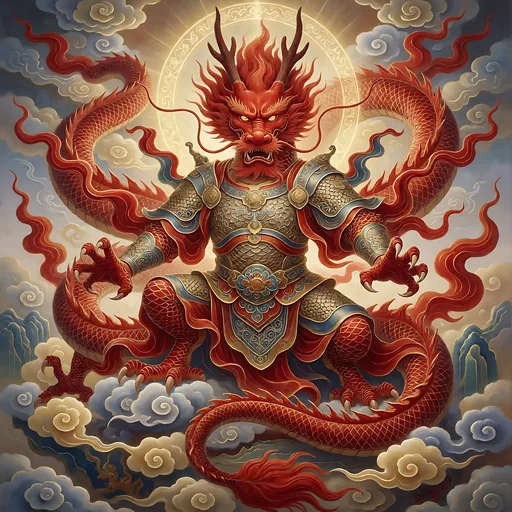
The Shan Hai Jing — the Classic of Mountains and Seas — is the oldest and strangest bestiary of the Eastern world. Compiled around the 4th century BCE, it describes the known world mountain by mountain, sea by sea, and in each region it lists the creatures that live there: what they look like, what their appearance means, and what they do to people who encounter them.
Western readers usually meet this material through pop culture, where the classic's creatures are flattened into monsters. The source text is more interesting: it is a field guide, and like any field guide it separates the dangerous from the beneficial. The creatures below are drawn from the beneficial side of the ledger.
The great families of creatures
Dragons and serpent-lords. Zhulong, the primordial crimson dragon of Mount Zhong, opens his eyes for daylight and closes them for night — day, darkness and the turning of seasons are his breath. Yinglong, the winged war-beast, decided a war that founded a realm. These are forces of nature given a face.
Fox spirits. The Nine-Tailed Fox of Mount Qingqiu is tied to flourishing family and protection from pestilence — a warm, protective presence in the source text, long before later folklore recast fox spirits as tricksters.
Birds of omen. The Phoenix of Mount Danxue appears when peace is coming. In this system, birds are messengers: their appearance is itself the message.
Guardian beasts proper. The Kaiming Beast stands atop Mount Kunlun with nine heads, gatekeeper of heaven. The Zheng of Mount Zhang’e is a crimson, five-tailed warder against evil. These are the threshold guardians — the ones you would want between you and what comes in the night.
How to tell a guardian from a monster
The classic is blunt about which is which. An ominous creature's appearance foretells disaster — flood, drought, war. An auspicious creature's appearance foretells blessing: peace, harvest, progeny, protection. When you read a passage, look for the verb attached to the creature's appearance. That single word tells you which side of the ledger it belongs on.
Every creature in our library is drawn from the auspicious side — 45 of them, each rendered not as a cartoon monster but as a majestic, armored deity portrait, the kind of guardian you would hang above a door.
The provenance rule
Each creature comes with its provenance card: the chapter and the original passage it is drawn from. In an age of endless AI imagery, provenance is the difference between a guardian and a stock image — and it is the difference between a tradition and a trend.
Which of the 45 guards you?
Your birth date and name, read through the classic's five elements and directions, select your guardian — with its true provenance card.
Find My Guardian — FreeSpirit Beast is an independent studio. Artwork is AI-assisted and human-curated, every creature drawn from the public-domain Shan Hai Jing. Privacy · Terms · Spirit animal vs guardian beast · Read next: What Is the Shan Hai Jing? — The Classic of Mountains and Seas, Explained · Nine-Tailed Fox Meaning — What the Classic Actually Says · Qilin Meaning — The Gentlest Guardian in the Eastern Bestiary